Quick Snapshot: Implant vs Bridge
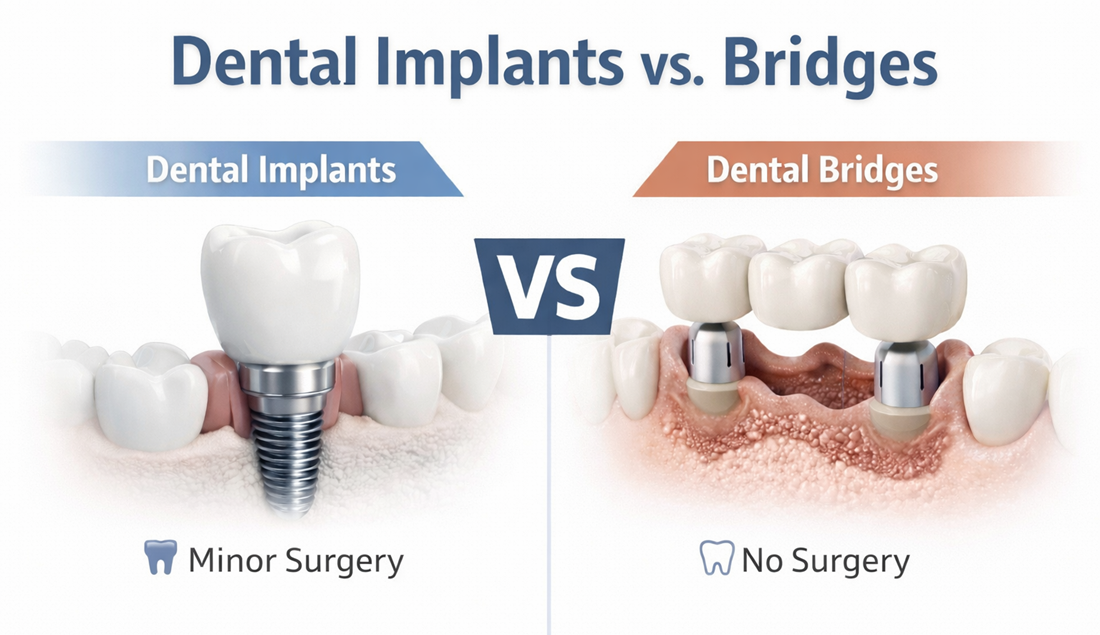
Dental implants replace the root and crown, while bridges replace only the crown. This is the fastest way to understand the trade-offs before you compare pricing or timelines.
- Implants help prevent bone loss
- Bridges rely on adjacent teeth
- Implants often last 20+ years
- Bridges typically last 10–15 years
- Implants require dental surgery
- Bridges usually do not
Ten-year implant survival averages about 95% (Jung et al., 2021). Fifteen-year survival for fixed bridges ranges from 70–85% (Pjetursson et al., 2015).
Why Replacing a Missing Tooth Is Not Optional
Bone loss begins immediately after a tooth is removed. Up to 50% of ridge width can disappear within the first year (Schropp et al., 2003).
This bone shrinkage affects bite alignment, facial structure, and future implant eligibility. Ignoring a missing tooth often leads to shifting teeth, chewing imbalance, and higher restorative dentistry costs later.
Dental Implants vs. Bridges: Core Structural Differences
Dental implants vs. bridges differ biologically, mechanically, and financially over time. The “implant vs bridge” choice is not just about looks.
| Feature | Dental Implants | Dental Bridges |
|---|---|---|
| Root Replacement | Yes | No |
| Bone Stimulation | Yes | No |
| Affects Neighbor Teeth | No | Yes |
| Surgery Required | Yes | No |
| Average Lifespan | 15–25+ years | 7–15 years |
Implants integrate with bone through osseointegration. Bridges transfer chewing forces to neighboring teeth, which can increase stress on those teeth over time.
What Is a Dental Implant?
A dental implant functions as an artificial tooth root. It replaces the missing tooth structure below the gumline, not just the visible part.
Most implants use titanium implants because long-term data supports their stability (Buser et al., 2017). Zirconia implants offer a metal-free alternative for patients focused on cosmetic dentistry or material preferences.
- Implant fixture (commonly titanium)
- Surface treatment to support bone integration
- Abutment connector
- Custom crown (often ceramic)
What Is a Dental Bridge?
A dental bridge fills a gap by attaching to adjacent teeth. A porcelain bridge may blend well visually, but it depends on support teeth for strength.
Bridges require permanent reshaping of adjacent teeth. Over time, abutment teeth may face increased stress or decay risk.
- Porcelain-fused-to-metal bridge
- All-ceramic bridge
- Zirconia bridge
- Cantilever or resin-bonded designs (case-dependent)
Implant vs Bridge: 20-Year Cost Comparison
Dental implants vs. bridges should be judged on lifetime value, not just the first invoice. The initial implant cost is often higher, but replacement cycles matter.
| City | Average Cost of Single Tooth Implant (2026) |
|---|---|
| Los Angeles | $4,500–$6,500 |
| San Diego | $4,200–$6,200 |
| Houston | $3,500–$5,500 |
| Dallas | $3,800–$5,800 |
Bridge cost typically ranges from $2,000–$4,500, depending on material and number of units.
Many bridges need replacement once or twice over 20 years, while implants may last decades with proper care.
Factors That Influence the Price of Your Dental Work
The final price depends on anatomy, materials, and the complexity of care. Two patients can receive the same treatment category and still have different costs.
Implant cost often changes based on bone grafting needs, imaging, crown materials, and whether same-day implants are appropriate. Bridge costs often change based on the number of units, material choice (porcelain bridge vs zirconia), and the condition of anchor teeth.
Cost of Dental Implants with Insurance (2026)
Cost of dental implants with insurance 2026 depends on how your plan defines “major restorative work.” Many PPO dental insurance plans cover a portion, but limits apply.
- Typical coverage: 40–50% after deductible
- Common annual maximum: $1,500–$2,500
- Waiting period is common for new policies
How long is the waiting period for insurance to cover major dental work? Many plans use a 6–12 month waiting period, especially for major procedures.
Best Dental Insurance for Major Restorative Work
Best dental insurance for major restorative work usually means a higher annual maximum and fewer exclusions. That is more useful than a low monthly premium if you expect implant or bridge care.
When you call your insurer, ask whether implants are covered, whether bone grafting is included, and whether there are frequency limits. Medicare typically does not cover routine implants or bridges in 2026.
Are Dental Implants Tax Deductible in 2026?
Are dental implants tax deductible in 2026 can be “yes,” depending on your total medical expenses. The IRS generally treats implants as a medical expense, but deductibility depends on your tax situation.
If total qualifying medical expenses exceed a percentage of adjusted gross income, you may be able to deduct part of the cost. Confirm with a licensed tax professional.
Dental Implant Payment Plans for Seniors
Dental implant payment plans for seniors often focus on predictable monthly costs. This can help retirees avoid a large upfront payment while still choosing a long-lasting option.
Common options include CareCredit, in-office financing, and fixed-payment healthcare lenders. Approval terms vary by credit and plan length.
Navigating CareCredit and Dental Financing in 2026
Dental financing can spread implant cost across months instead of a single payment. This is one of the most practical ways to keep care affordable without changing your treatment goals.
Review promotional terms carefully, especially deferred-interest rules and the APR after the promo window. If your plan includes a payoff date, put it on a calendar.
Affordable Dental Bridge Options Without Insurance
Affordable dental bridge options without insurance usually depend on material selection and bridge design. A standard porcelain-fused-to-metal bridge typically costs less than full zirconia.
Cost still depends on the number of units and whether anchor teeth need extra treatment. Even when a bridge looks cheaper upfront, replacement cycles can raise total cost later.
Is Dental Surgery Required?
Dental implants vs. bridges differ significantly in surgical need.
Implants require dental surgery under local anesthesia, while bridges generally do not.
Bridges still involve irreversible enamel reshaping and may affect dental health of the anchor teeth. Same-day implants may be an option in select cases if stability targets are met.
Dental Implant Recovery Time vs Bridge Procedure
Dental implant recovery time vs bridge procedure is one of the biggest day-to-day differences for patients.
Bridge treatment often finishes in weeks, while implants usually require months for bone integration.
Implants typically need 3–6 months for osseointegration before final restoration. Most patients resume normal activity within 24 hours after implant placement, though healing continues below the surface.
Oral Surgeon vs General Dentist: Who Should Place Implants?
Oral surgeon involvement is most common when the case is complex.
Complex care often includes bone grafting, sinus lifts, or multiple implants.
Trained general dentists may place straightforward single-tooth implants in suitable cases. If your case includes limited bone, nerve proximity, or prior implant failure, ask who will handle the surgical phase.
The Role of 3D Imaging and Guided Surgery
3D imaging improves implant planning and safety.
CBCT-based planning can reduce certain complications and helps clinicians avoid critical anatomy.
Three-dimensional planning has been linked to improved placement accuracy, with reduced risk of nerve injury in properly planned cases (Nickenig et al., 2010).
AI-Driven Diagnostics in 2026
AI-driven diagnostics can support more predictable implant planning before surgery.
In 2026, some systems use AI-assisted analysis of CBCT data to assess bone density, cortical thickness, and stability indicators.
Important: Avoid absolute promises like “99% success rate” for marketing or compliance reasons. A safer, accurate version is:
AI-assisted bone analysis can help clinicians estimate primary stability and plan implant position more precisely before surgery.
3D Printing for Modern Dental Bridges
3D printing and digital fabrication can improve bridge fit and speed in some cases.
Digital workflows can reduce adjustment visits and support better marginal fit when executed well.
CAD/CAM and 3D manufacturing may include digital impressions, design simulation, and precision milling or printing steps. A better marginal seal may help reduce decay risk at bridge margins.
Bone Grafting and Sinus Lift Procedures
Bone grafting can make implants possible when bone volume is low.
It helps rebuild ridge width or height so the implant can stabilize.
Common graft materials include autograft, allograft, xenograft, or synthetic options. Guided bone regeneration has shown favorable outcomes in clinical research.
Mini Dental Implants vs Traditional Implants
Mini dental implants are smaller-diameter implants used in limited situations.
They may reduce invasiveness and cost, but long-term load capacity can be a limiting factor.
If you have heavy bite forces or need strong posterior support, traditional implants are often preferred. Mini implants can still be useful in select cases with specific goals and anatomy.
Dentures vs Implants: Full Mouth Options
Full mouth implants can provide stability that dentures cannot match.
For patients who struggle with denture movement, implant-supported options may improve chewing and comfort.
All-on-4 treatment has shown survival above 94% at 10 years in published studies (Malo et al., 2011). Dentures remain a non-surgical alternative but may contribute to ongoing bone loss.
Signs of Implant Failure
Early detection of implant complications improves the chance of saving the restoration. Problems are easier to address when caught early.
- Persistent pain that does not improve
- Mobility or looseness
- Swelling or drainage
- Bone loss visible on imaging
Ten-year implant failure rates often fall around 3–5% (Jung et al., 2021). Smoking is linked to higher failure risk in multiple analyses (Chrcanovic et al., 2015).
Diabetes and Implant Success
Controlled diabetes can have implant outcomes similar to non-diabetic patients. Risk rises with poor glycemic control.
Studies have reported that well-managed diabetes can still support predictable implant integration, while uncontrolled diabetes increases complication risk.
Can You Get a Dental Bridge After an Implant Fails?
Can you get a dental bridge after an implant fails? Yes, in many cases. The key is whether the adjacent teeth are healthy enough to serve as anchors.
In some cases, a failed implant can be replaced after healing and possible grafting. If re-implantation is not appropriate, a bridge can be a practical fallback option.
When Does a Dental Bridge Need Replacement?
Most bridges last about 10–15 years, but replacement timing depends on hygiene and anchor tooth health. A bridge does not fail all at once, so the early signs matter.
- Decay under crowns
- Fracture or chipping
- Gum recession around margins
- Loose feeling or bite changes
Maintenance and Long-Term Care Cost
Maintenance determines the true lifetime expense of tooth replacement. Implant restorations and bridges both need consistent hygiene and professional monitoring.
Peri-implantitis has been reported in about 10–20% of implants depending on definitions and populations (Derks & Tomasi, 2015). Bridges require special cleaning under the pontic using floss threaders or similar tools.
Signs You Are a Candidate for Dental Implants
Signs you are a candidate for dental implants include adequate bone, healthy gums, and stable medical conditions. A clinical exam and imaging confirm what your anatomy supports.
- Sufficient bone volume (or a plan for bone grafting)
- Healthy periodontal status
- Non-smoker or willing to quit
- Controlled diabetes or other systemic conditions
- Good daily oral hygiene
Making the Decision
Dental implants vs. bridges should be chosen based on bone condition, overall health, finances, and long-term expectations. A structured evaluation with imaging and a written treatment plan usually makes the decision clearer.
Patients looking for implant placement, bridge restoration, bone grafting, and digitally planned restorative dentistry can consult licensed providers who use CBCT imaging, AI-assisted planning, and modern fabrication methods.
For patients comparing options across California and Texas, Gold Coast Dental offers evaluations, imaging-based planning, and restorative treatment options.
You can check our locations page to find your nearest Gold Coast Dental location, then choose whether to call us now (562) 242‑1411 or book a session for a consultation. If you want more location-specific guidance, you can also read our local guide to dental care in your area.
Last reviewed February 2026.