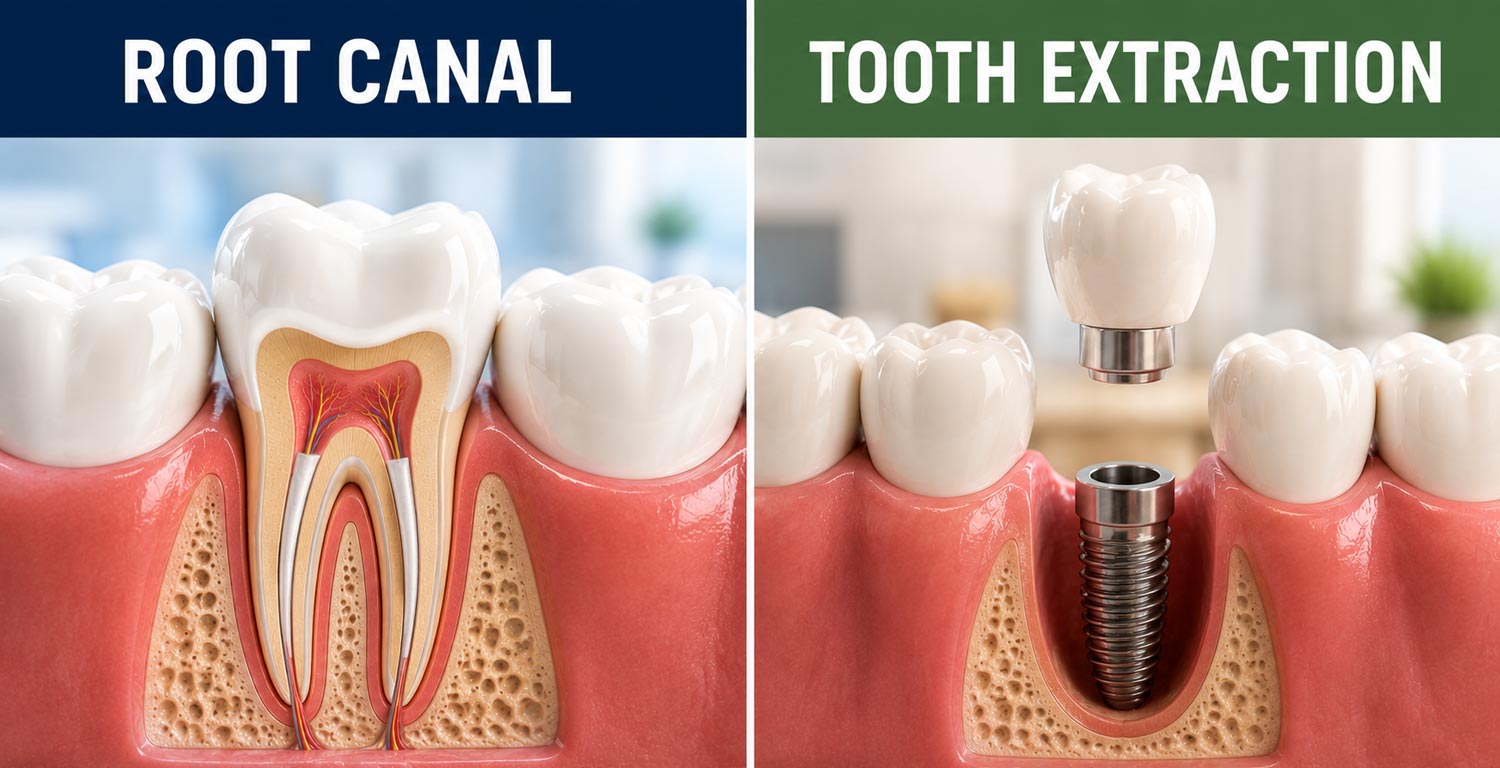
A badly damaged or infected tooth can leave you facing a difficult choice: try to save it with a root canal or remove it with an extraction. Both treatments can relieve pain and address infection, but they lead to very different next steps for the tooth and your smile.
At Gold Coast Dental, we look at how much healthy tooth structure remains, the condition of the root and surrounding bone, your symptoms, and the long-term outlook before recommending treatment. If the tooth has a good chance of lasting, root canal therapy may allow us to preserve it. If the damage is too severe, extraction may be the better option.
Cost, recovery time, pain, and future dental work can all affect the decision. Understanding the full treatment path can make the choice easier, especially when an extraction may later lead to an implant, bridge, or another replacement. Here’s how root canal therapy and extraction compare, and how we decide which option makes the most sense for your tooth.
Root Canal vs. Tooth Extraction: What’s the Difference?
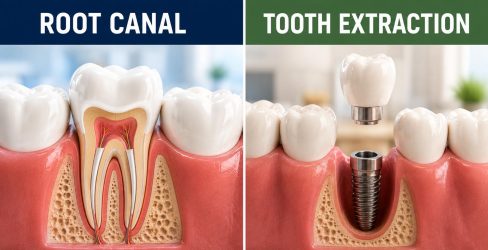
A root canal and a tooth extraction can both treat a badly damaged or infected tooth, but each procedure changes the tooth in a different way.
| Comparison | Root Canal | Tooth Extraction |
|---|---|---|
| What happens | We remove infected or damaged tissue from inside the tooth, clean the canals, and seal the space. | We remove the entire tooth from its socket. |
| What remains | The root and remaining natural tooth structure stay in place. | An open space remains after the tooth is removed. |
| Restoration afterward | A filling, onlay, or crown may be used to rebuild and protect the tooth. | You may later consider an implant, bridge, or another replacement option. |
| Treatment focus | Preserve a tooth that still has a reasonable long-term outlook. | Remove a tooth that cannot be restored reliably or is causing ongoing problems. |
| Next step | Complete the final restoration and continue regular dental care. | Allow the site to heal and decide whether the missing tooth should be replaced. |
With a root canal, we clean and disinfect the inside of the tooth, then seal it to reduce the chance of reinfection. The tooth remains in your mouth and can continue to function once we restore and protect it.
With an extraction, we remove the tooth because its condition makes saving it less predictable. We then check the surrounding gums and bone and talk with you about healing and replacement options when they apply.
When Is a Root Canal a Good Option?
We may recommend root canal therapy when the inside of a tooth becomes infected or badly inflamed but the tooth still has enough healthy structure to restore. During treatment, we remove the damaged pulp, clean and disinfect the inside of the tooth, and seal it so the natural tooth can stay in place.
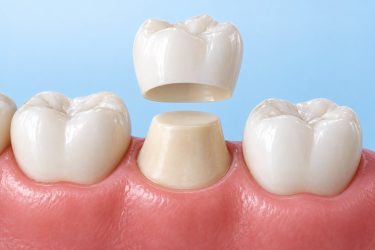
Deep decay can reach the pulp and cause persistent pain, lingering sensitivity, swelling, or infection. If enough healthy tooth structure remains, we can often treat the infection with a root canal and restore the tooth with a filling or crown afterward.
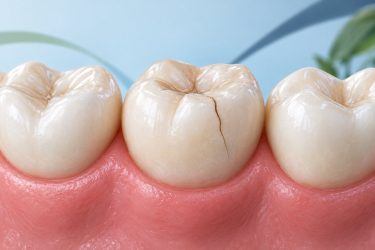
A cracked or injured tooth may also need root canal treatment when the damage reaches the pulp. We look closely at the location and depth of the crack because some cracks can still support a restoration, while others extend too far below the gumline or into the root.
Complimentary New Patient Offer
Get Seen by a Dentist Today
Your initial exam and X-rays are complimentary. Call Gold Coast Dental or choose your nearest location and schedule an appointment online.
An abscess or infection around the root can sometimes be treated without removing the tooth. We consider how much healthy tooth structure remains, the condition of the surrounding bone and gums, any previous dental work, and the overall strength of the tooth before recommending treatment.
If we can save the tooth, keeping it in place helps maintain normal chewing and can spare you from needing a replacement tooth later. We also consider how well the tooth is likely to hold up after treatment so you understand what to expect in the years ahead.
When Is Tooth Extraction a Better Option?
We may recommend an extraction when a tooth has too much damage to restore predictably or when keeping it could lead to ongoing pain, infection, or other problems.
Extraction may make sense when:
- A crack extends deep into the root. Root canal therapy can treat infection inside a tooth, but it cannot repair a root that has split.
- Decay has destroyed too much of the tooth. A dental crown needs enough healthy structure to hold securely. Severe decay can leave too little tooth behind to rebuild.
- Gum disease has weakened the tooth’s support. Significant bone loss can leave a tooth loose and unstable even if the tooth itself could otherwise be treated.
- Previous treatment has failed. In some cases, retreatment or endodontic surgery may still help. In others, the remaining tooth structure or repeated infection may make extraction the more reliable choice.
- Trauma has badly damaged the tooth. A severe fracture can extend too far below the gumline or into the root for us to restore the tooth successfully.
📚 Related reading: 24 Signs You May Need Tooth Extraction
If we recommend extraction, we will explain why and talk through what comes next. Depending on the location of the missing tooth, your bite, the health of nearby teeth and bone, and your preferences, we may discuss a dental implant, bridge, or another replacement option after the area heals.
Root Canal vs. Extraction: Which Hurts More?
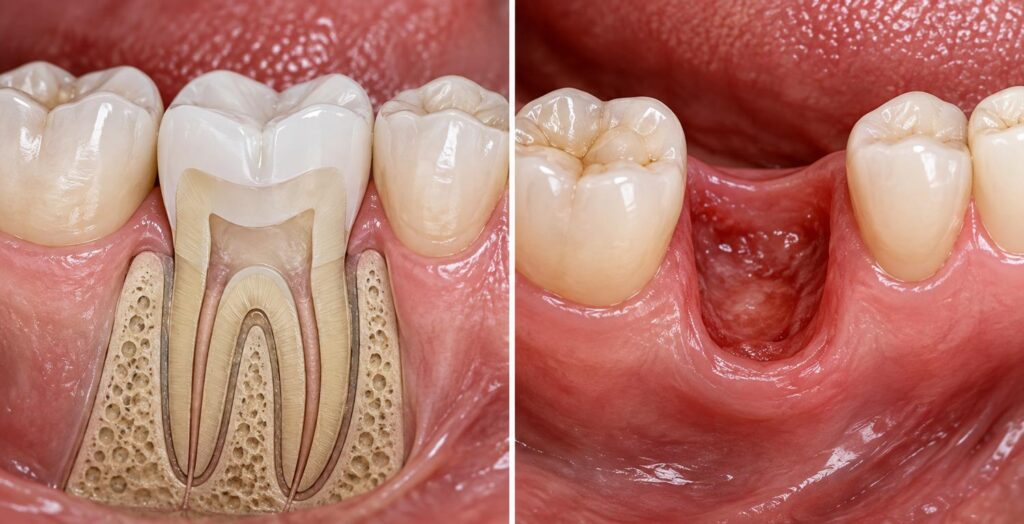
Both procedures use local anesthesia to numb the treatment area. During a root canal, we numb the tooth while we remove infected or damaged tissue from inside it. During an extraction, we numb the tooth and surrounding tissues before removing the tooth.
What to Expect After a Root Canal
Most people feel some tenderness or soreness for a few days after a root canal, especially if the tooth was badly inflamed or infected before treatment. The tooth may also feel sensitive when you bite until the tissues around the root settle.
Many patients return to their usual routine quickly. If the tooth still needs its final crown or other restoration, we may ask you to avoid chewing hard foods on that side until we finish protecting the tooth.
What to Expect After an Extraction
An extraction creates a socket that needs time to heal. Soreness, swelling, and tenderness are common during the first few days, and we usually recommend avoiding chewing directly on the extraction site while the area begins to close.
Many patients return to normal daily activities within a few days. The gum continues to heal after that, and deeper bone healing takes longer even after the area starts to feel normal.
Which Recovery Is Easier?
Root canal recovery is often shorter because we keep the tooth in place and do not create an extraction socket. An extraction can involve more soreness during the first few days, especially when the tooth requires surgical removal or the surrounding tissues were already inflamed.
Your experience will also depend on the condition of the tooth before treatment. A severe infection, significant swelling, difficult anatomy, or a more involved extraction can affect recovery. In many cases, treating the damaged or infected tooth brings relief from the pain that led you to see us in the first place.
After either procedure, we will give you clear instructions for managing soreness, eating, brushing, and caring for the area as it heals. We also let you know which symptoms are expected and when you should call us.
Root Canal vs. Tooth Extraction: How Do the Costs Compare?
Cost can play a big part in the decision between saving and removing a tooth. A simple extraction generally costs less at the time of treatment, but the total can change if you later replace the missing tooth with an implant or bridge.
At Gold Coast Dental, we base your cost on the tooth, treatment complexity, restorative needs, and insurance coverage. The ranges below can help you compare the expected cost of each treatment path.
| Treatment Path | Estimate* | What to Keep in Mind |
|---|---|---|
| Root canal – front tooth | $900-$1,600 | A filling or crown may be needed afterward. |
| Root canal – premolar | $1,100-$1,900 | A crown is often recommended to protect the treated tooth. |
| Root canal – molar | $1,400-$2,200 | Molars often cost more because they usually have more canals and more complex anatomy. |
| Dental crown | $900-$2,500 | Added when a crown is needed after root canal treatment. Material and tooth location affect cost. |
| Simple tooth extraction | $150-$350 | Replacing the missing tooth may add another treatment cost later. |
| Surgical tooth extraction | $250-$650+ | Complexity, impaction, sedation, and other care can affect the final fee. |
| Single dental implant with crown | $3,100-$5,800 | One option for replacing a tooth after extraction. Bone grafting or other procedures may add cost when needed. |
| Traditional dental bridge | $2,000-$5,200 | Another option for replacing a missing tooth; cost varies with the span, materials, and supporting teeth. |
* Pricing shown is for general reference only and is not guaranteed. Actual treatment costs may vary based on your individual needs, insurance coverage, and other factors. Prices are subject to change without notice. Contact Gold Coast Dental for current pricing and a personalized treatment estimate.
The location of the tooth, number of canals, extent of infection or damage, type of extraction, restorative materials, insurance coverage, and other clinical needs can all affect the final amount you pay.
An extraction can have the lowest initial price, but replacement changes the comparison. If we can save a tooth with root canal therapy, the treatment path may include the root canal and a final restoration. If we remove the tooth, the treatment path may include the extraction plus an implant, bridge, bone graft, or other care when replacement is appropriate.
📚 Related reading: How Can I Fix My Teeth If I Don’t Have Money?
Before treatment, we review your X-rays, explain the options available for your tooth, check your insurance benefits, and provide an estimate so you can compare the expected costs before deciding how to proceed.
Complimentary New Patient Offer
Get Seen by a Dentist Today
Your initial exam and X-rays are complimentary. Call Gold Coast Dental or choose your nearest location and book an appointment online.
Which Option Has Better Long-Term Results?
A properly treated and restored tooth can remain functional for many years after a root canal. The American Association of Endodontists reports that root canal-treated teeth can last for many years, and some last a lifetime with good oral hygiene, regular dental care, and a strong final restoration.
Several factors can affect how well a root canal-treated tooth holds up over time:
- Remaining tooth structure: The tooth needs enough healthy structure to support a filling, onlay, or crown.
- Bone and gum support: Healthy tissues around the tooth help keep it stable and functional.
- Cracks or fractures: A deep crack can weaken the tooth even after we treat the infection inside it.
- The final restoration: A well-fitting crown or filling helps protect the treated tooth from new damage and leakage.
- Future decay or gum disease: New dental problems can shorten the life of any restored tooth, including one that has had root canal treatment.
If we remove the tooth, you may then need to decide how to manage the open space. Dental implants and bridges can both provide long-term tooth replacement when they fit the patient’s oral health, bone support, bite, and restorative needs.
Research comparing root canal-treated teeth with implant-supported replacements has found high survival rates for both approaches. Recent systematic reviews have not identified one choice that works best for every patient. We consider the condition of your natural tooth, bone and gum health, restorative needs, treatment time, cost, and your preferences before recommending a path forward.
When a tooth has a strong outlook after treatment, we generally prefer to preserve it. If extensive damage makes that outlook poor, removing the tooth and planning an appropriate replacement can provide a more predictable path forward.
How Do We Decide Between a Root Canal and Extraction?
We don’t make this decision based on pain alone. A tooth can hurt badly and still be very treatable, while another tooth with only mild symptoms may have a deep crack, severe decay, or advanced bone loss.
During your exam, we look at the tooth, surrounding gums and bone, dental X-rays, and any previous dental work. We also consider what treatment would come afterward and how each option fits your long-term dental needs.
| What We Check | Why It Matters |
|---|---|
| Remaining tooth structure | The tooth needs enough healthy structure to support a filling, onlay, or crown after root canal treatment. |
| Cracks or fractures | A crack that extends deep into the root can make the tooth difficult or impossible to restore reliably. |
| Bone and gum support | Severe bone loss or advanced gum disease can leave the tooth too unstable to keep. |
| Extent of decay or infection | We look at how much damage has occurred, where the infection is located, and how much healthy tooth remains. |
| Previous dental treatment | Large fillings, crowns, previous root canals, or repeated repairs can affect the tooth’s strength and available treatment options. |
| Long-term outlook | We consider how likely the tooth is to remain healthy, comfortable, and functional after treatment. |
| Treatment after the procedure | A root canal may require a crown, while an extraction may lead to an implant, bridge, or another replacement option. |
| Cost and treatment time | We explain the full treatment path so you can compare the appointments, healing time, future care, and expected costs involved. |
Once we have the full picture, we can explain which options make sense for your tooth, why we recommend one over another, and what you can expect from each treatment path.
What Happens If You Wait Too Long?
A damaged or infected tooth can quickly turn into a dental emergency. Decay can spread deeper, cracks can worsen, and infection can move into the tissues around the root.
A tooth that we could have treated with a root canal may eventually lose too much healthy structure to support a crown. If that happens, extraction may become the only practical option.
Waiting can also lead to:
- Increased pain, pressure, or temperature sensitivity
- Swelling around the tooth, gums, jaw, or face
- A dental abscess or drainage near the affected tooth
- Bone loss around the root or worsening gum support
- A larger fracture in an already weakened tooth
- More involved treatment, additional appointments, and higher overall costs
Pain can sometimes fade even while the problem gets worse. If the nerve inside the tooth dies, you may feel less discomfort for a while even though infection remains around the root or in nearby tissues.
If you have persistent tooth pain, swelling, pain when biting, or a tooth that suddenly stops hurting after severe pain, we recommend coming in for an exam. Seeing the tooth earlier can give us more treatment options and a clearer picture of whether we can preserve it.
Talk With Us About Saving or Removing the Tooth
If you are dealing with ongoing tooth pain, swelling, sensitivity, pain when biting, or a damaged tooth, we can examine the area and explain what your options look like.
At Gold Coast Dental, we consider the condition of the tooth, your X-rays, long-term outlook, recovery, restorative needs, and expected costs before recommending treatment. When we can preserve the natural tooth with a good chance of success, we will explain how root canal therapy may help. If the tooth has too much damage to restore reliably, we will walk you through extraction and any replacement options that may make sense afterward.
If you are unsure which treatment you need, contact us to schedule an exam at a Gold Coast Dental location near you. We can show you what we see on your X-rays, answer your questions, and provide a personalized treatment estimate before you decide how to proceed.
📞 Schedule an appointment today to have your tooth evaluated and discuss whether a root canal, extraction, or another treatment option makes the most sense for you.
Complimentary New Patient Offer
Get Seen by a Dentist Today
Your initial exam and X-rays are complimentary. Call Gold Coast Dental or choose your nearest location and schedule an appointment online.